Small
Bichon Frise
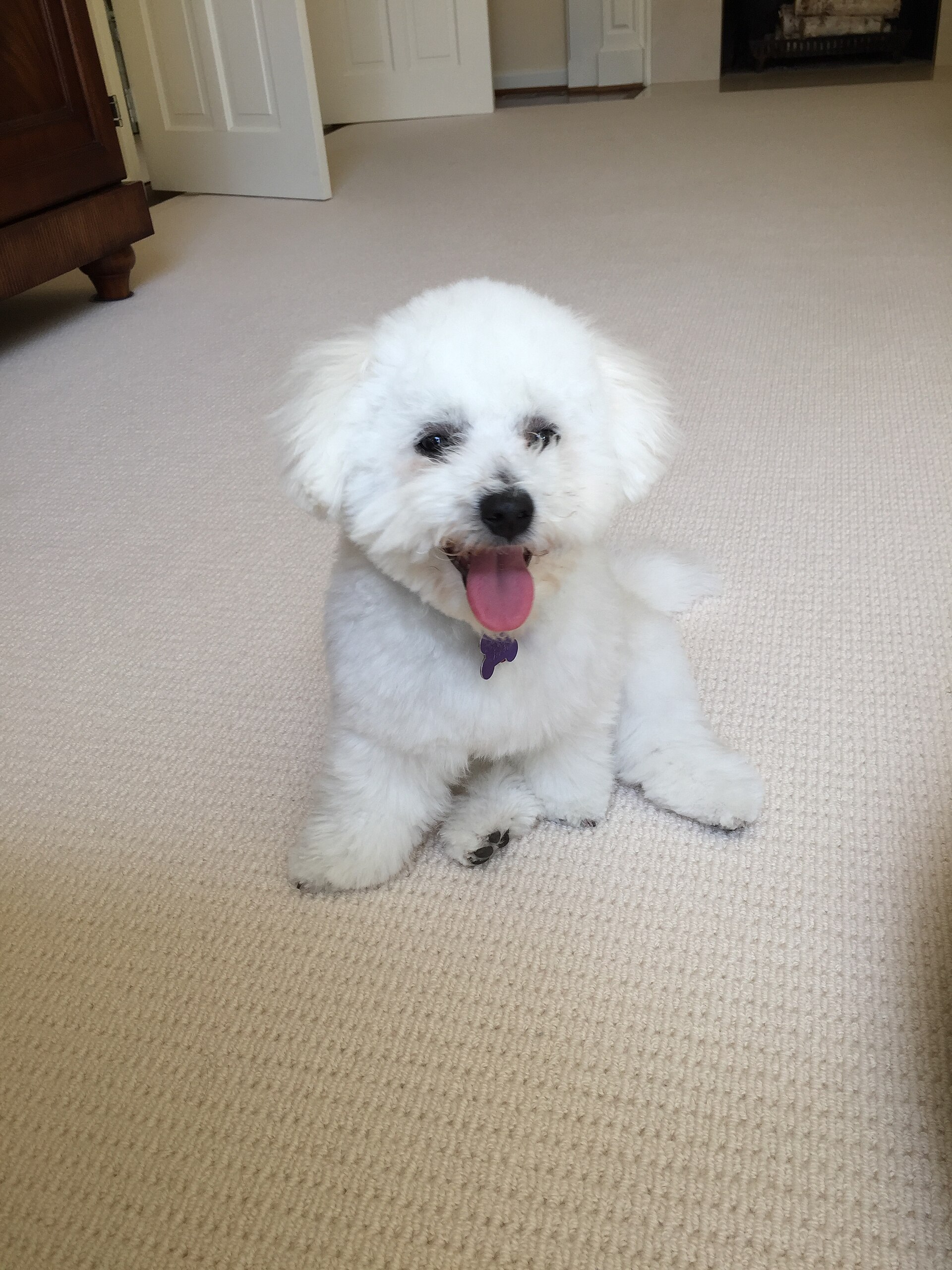
The Bichon Frise is a small white companion dog with a lively outline and a coat of loose corkscrew curls. The FCI standard gives the origin as Franco-Belgian and says the dogs were brought to France from Italy in the Renaissance.
A full white coat can look like a stuffed toy. That appearance is hair and often a trim. It is not a breed called “teddy bear,” and it is not a promise about temperament. The teddy bear dog breeds guide covers that distinction.
Quick facts
- Height
-
FCI: 25–29 cm at the withers. Males may be 1 cm taller, and females 2 cm shorter, if the proportions stay balanced. Royal Kennel Club ideal: 23–28 cm (9–11 in). The AKC lists 9.5–11.5 inches.
- Weight
-
FCI: about 5 kg, in proportion to size. The AKC lists 12–18 pounds, which is heavier than 5 kg. Both listings are cited here. They are not averaged into a third number.
- Coat
-
A profuse double coat. The outer hair forms loose spiral curls, with a soft, dense undercoat (FCI). The Royal Kennel Club describes the coat as fine and silky, 7–10 cm (3–4 in) long, and says the dog may be presented trimmed or untrimmed. Colour is white. The FCI allows a slight beige tinge on no more than 10% of the coat before 12 months. The Kennel Club allows cream or apricot markings up to 18 months. In the directory, this measured coat length is filed under medium.
- Lifespan
-
14–15 years, as listed by the AKC.
- Origin
-
Franco-Belgian, with patronage shared by France and Belgium (FCI). The historical summary says the breed arrived in France from Italy and was later popular in Belgium and France.
Recognising the breed
The FCI standard says the Bichon is longer than it is tall, with the tail carried in a graceful curve over the back. The eyes are dark, lively, and expressive. Eyes and nose should read as three dark points in an equilateral triangle on a white head.
The round silhouette is mostly coat. Loose corkscrew curls stand off the body. A rounded trim, sometimes called a powder-puff clip, is a haircut. The Kennel Club standard allows the dog to be shown trimmed or untrimmed.
The dog in the photograph has a short, rounded white coat and is one freshly groomed pet. It shows the curly texture. It is not a diagram of the 7–10 cm show length.
Temperament and activity
The FCI standard describes a companion that can be taken along, is neither nervous nor a frequent barker, is sociable with people and dogs, adapts readily, and is very attached to its people.
Those lines are the standard, not a test result for the dog you are looking at. A Bichon can be wary, noisy, or unhappy with other dogs. The white curls do not settle that question.
Attachment is part of the written standard, so a dog that matches it is a poor fit for very long hours alone. Energy is real — the standard mentions a lively gait — and it is still the energy of a small companion, which varies from dog to dog.
Grooming
Curls mat underneath if they are only patted on top. The coat needs combing through to the skin. The Kennel Club length of 7–10 cm is the show description; trimming is explicitly allowed.
A shorter pet clip is still a Bichon Frise. The white coat shows dirt, and hair around the eyes needs to be kept clear. Plan on coat care for as long as the dog keeps a curly coat, not only before a photograph.
Similar breeds
-
Shih Tzu
The Shih Tzu has a long, dense coat that is not curly, a broad round head, and hair that grows upward on the muzzle. Any colour except merle is allowed, and the height cap is 27 cm. The Bichon is white, with corkscrew curls and a tail curved over the back. Both can look round. The coat texture and the Shih Tzu’s chrysanthemum muzzle are the visible differences.
Discovery guides
Sources
- FCI breed standard No. 215, Bichon à poil frisé (4 April 2016) Accessed 9 October 2026.
- The Royal Kennel Club breed standard, Bichon Frise Accessed 9 October 2026.
- American Kennel Club, Bichon Frise Accessed 9 October 2026.