Giant
Great Dane
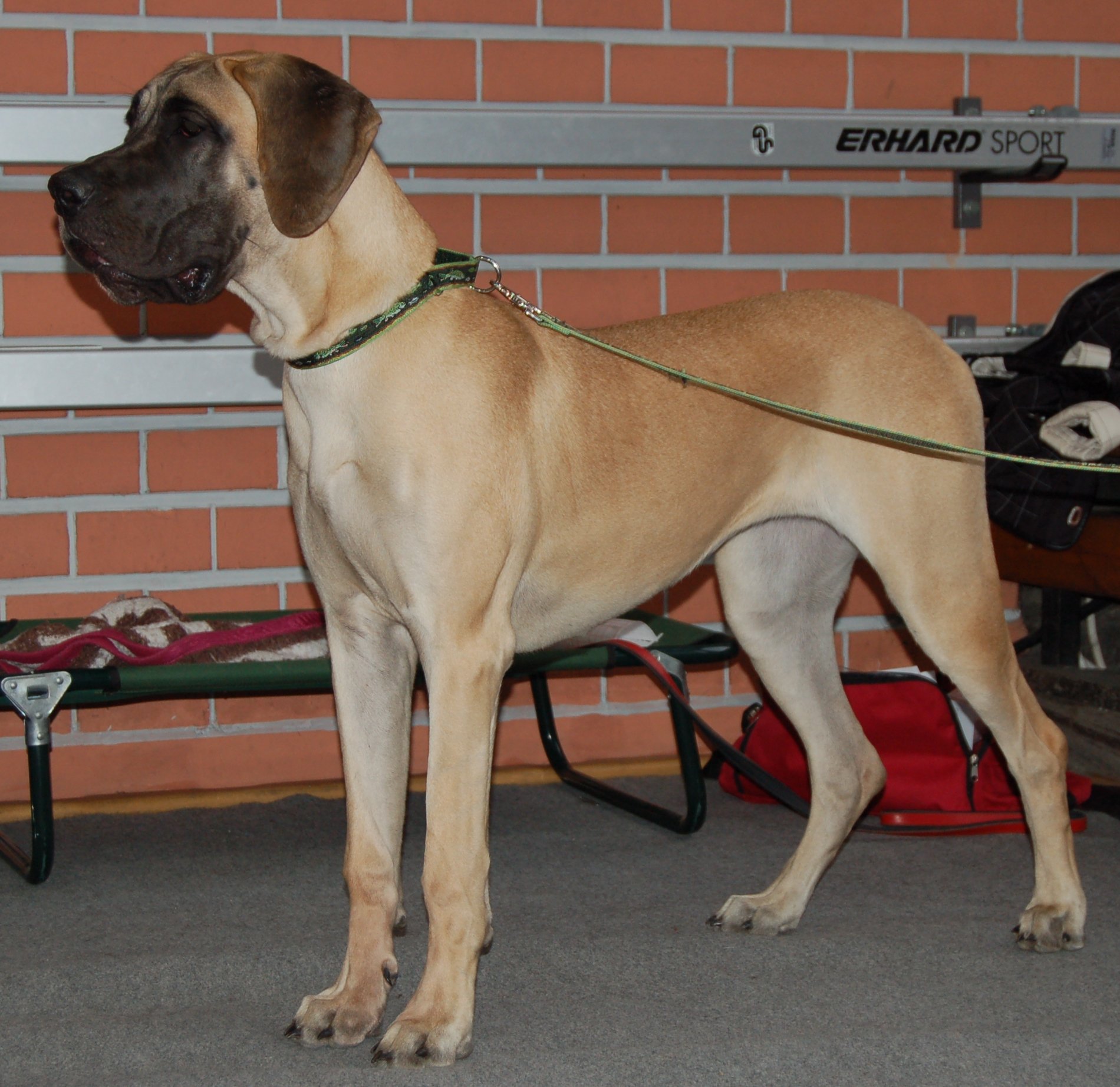
The Great Dane is a tall, short-coated companion from Germany. The FCI standard describes a large, powerful body that should still look balanced and noble rather than coarse, with males especially close to square.
Height depends on which club’s standard you read. The FCI publishes a floor and a ceiling. The AKC publishes a shorter range. Those are both breed-standard figures, not a record held by one dog.
Quick facts
- Height
-
FCI, at the withers: males at least 80 cm and not over 90 cm; females at least 72 cm and not over 84 cm. AKC: 30–32 inches for males and 28–30 inches for females. Royal Kennel Club minimum over 18 months: 76 cm (30 in) for dogs and 71 cm (28 in) for bitches.
- Weight
-
AKC: 140–175 pounds for males and 110–140 pounds for females. Royal Kennel Club minimum over 18 months: 54 kg (120 lb) for dogs and 46 kg (100 lb) for bitches. The FCI standard does not set a weight.
- Coat
-
Very short, dense, smooth, and close-lying. The FCI standard says the coat must not be coarse, dull, or a double coat. Colour varieties in that standard are fawn and brindle, harlequin, merle and black, and blue.
- Lifespan
-
7–10 years, as listed by the AKC.
- Origin
-
Germany. The FCI historical note links the breed to older bull-biters and hunting dogs, and says the name Dogge first meant a large, powerful dog rather than one breed.
Recognising the breed
The head is long, narrow, and expressive, never wedge-shaped. The FCI standard asks for the muzzle and the skull to be about equal in length, with the toplines of muzzle and skull parallel.
The body is almost square, particularly in males. Females may be a little longer. The short coat leaves the neck, chest, and legs easy to see, which is the opposite of a plush or rough outline.
Fawn, in the FCI standard, runs from light gold to deep gold, and a black mask is desired. The dog in the photograph is one fawn dog with a dark mask and drop ears. Other colour varieties exist, and this picture is not a measurement of breed height.
Temperament and activity
The FCI standard asks for a dog that is friendly, loving, and devoted to its owners, possibly reserved with strangers, and confident without aggression. The listed use is companion, watch dog, and guard dog.
A standard is a breeding description. It does not promise that every Dane will be easy with visitors, patient with children, or calm in a small flat. Meet the dog in front of you.
Activity follows the build. This is a tall, heavy companion, not a coursing hound. Ordinary walks and a chance to move in a straight line suit the standard’s purpose better than assuming one exercise plan fits every dog.
Grooming
There is no long coat to maintain. The close, glossy coat sheds short hair, and a rubber brush or a damp cloth is enough for the coat itself.
The short coat also makes skin and condition easy to see. Grooming time is ordinary care of nails and teeth on a heavy dog, not clipping.
Similar breeds
-
Irish Wolfhound
The Wolfhound has a rough coat, a beard, wiry hair over the eyes, and a back longer than its height. The Dane is smooth-coated and nearly square. On AKC figures the Wolfhound’s male minimum (32 inches) is the top of the Dane’s listed male range (30–32 inches). On FCI figures a Dane male may stand from 80 cm to 90 cm, which overlaps and can exceed the Wolfhound’s desired minimum of 79 cm.
-
Saint Bernard
The Saint Bernard has a broader head, a body longer than it is tall, and either a short double coat or a medium-length double coat, usually white with red. The Dane’s outline is cleaner and taller at the FCI male minimum.
Discovery guides
Sources
- FCI breed standard No. 235, Great Dane (21 August 2024) Accessed 9 October 2026.
- The Royal Kennel Club breed standard, Great Dane Accessed 9 October 2026.
- American Kennel Club, Great Dane Accessed 9 October 2026.