Giant
Saint Bernard
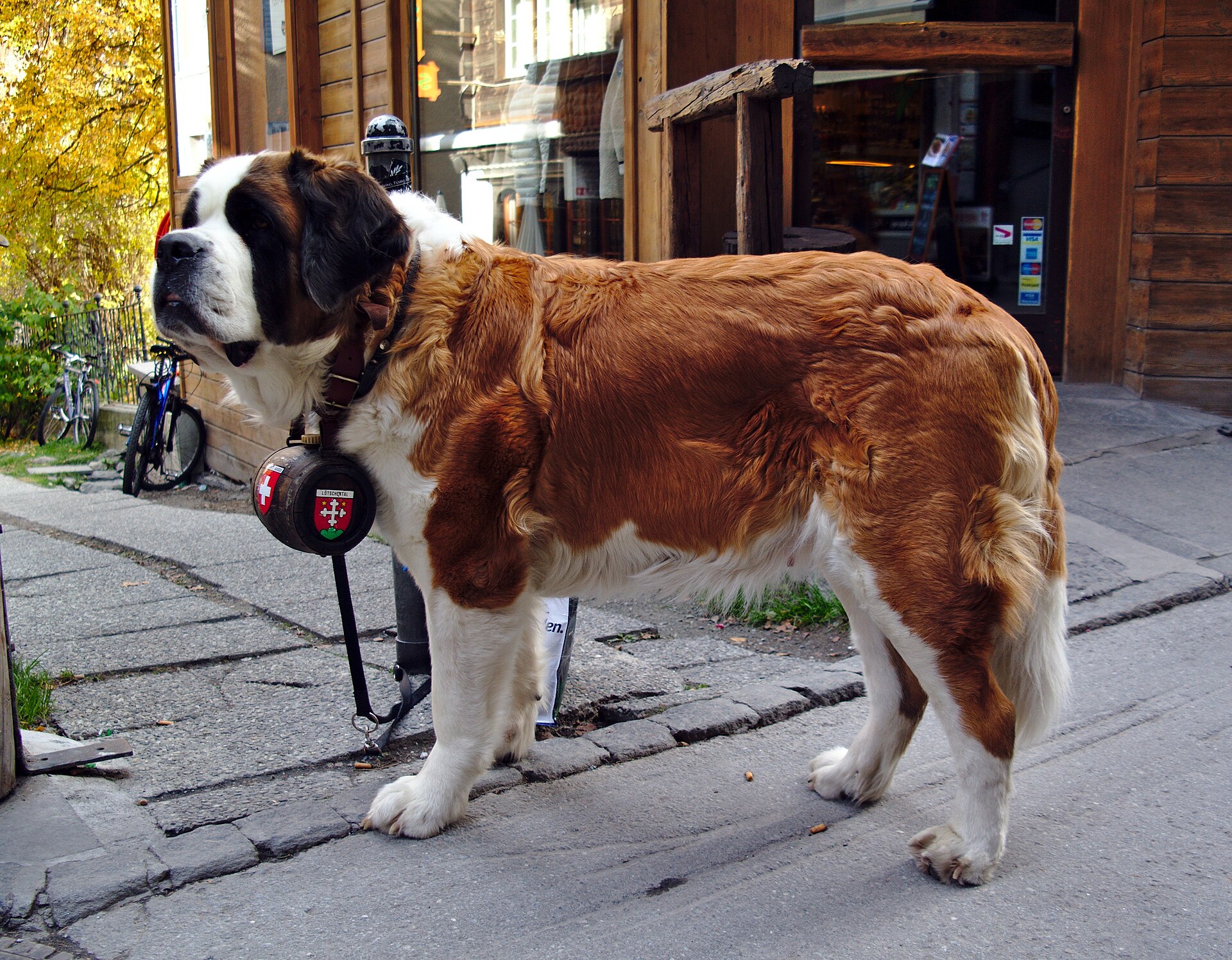
The Saint Bernard is a large, powerful mountain dog from Switzerland. The FCI standard describes two coat varieties that share the same substantial build: a short, smooth double coat and a longer, straight coat of medium length.
Clubs do not publish one shared height. The figures below are copied from each standard, because the minimums are not the same.
Quick facts
- Height
-
FCI: males at least 70 cm and up to 90 cm; females at least 65 cm and up to 80 cm. Dogs over the maximum are not penalised if the overall appearance stays balanced and the movement is sound. The Royal Kennel Club minimum is 75 cm (30 in) for dogs and 70 cm (28 in) for bitches. The AKC lists 28–30 inches for males and 26–28 inches for females.
- Weight
-
The AKC lists 140–180 pounds for males and 120–140 pounds for females. The FCI standard does not set a weight.
- Coat
-
Two varieties. The short-haired coat is dense, smooth, close-lying, and coarse, with plenty of undercoat. The longhaired variety has a straight topcoat of medium length, also with plenty of undercoat, feathering, and a bushy tail. The usual colour is white with clear red to dark red patches or a mantle.
- Lifespan
-
8–10 years, as listed by the AKC.
- Origin
-
Switzerland. The FCI standard traces the modern breed to large mountain dogs kept at the hospice on the Great St. Bernard Pass from the middle of the 17th century, used as companions and to find travellers lost in snow and fog.
Recognising the breed
The head is powerful and broad, with a steep stop. In the FCI standard the muzzle is deep for its length: depth to length is almost 2:1, and the muzzle is a little longer than one third of the head.
Eyes are dark brown to nut-brown and moderately deep set, with a friendly expression. The ears are medium-sized, triangular, and pendant, set high and wide.
White markings are required on the chest, feet, tip of the tail, muzzle band, blaze, and a patch on the neck. A white collar and a symmetrical dark mask are desirable. The body is a little longer than it is tall. The ideal ratio of height to body length is 9:10.
The barrel in the photograph is a prop. It is not described in the breed standard.
Temperament and activity
The FCI standard calls the temperament friendly, calm to lively, and watchful, and lists the breed as a companion, watch dog, and farm dog.
That is a club description of the breed, not a guarantee about a particular dog. Health, upbringing, and the individual change how those traits show up.
The practical constraint is mass. A calm dog of this size still needs room to turn around, lie down, and walk without being asked to work like a sighthound.
Grooming
Both varieties are double coats, so they shed. The short coat lies close. The longhaired coat is medium in length, with feathering on the legs and a bushy tail, and those areas mat if they are ignored.
Brushing is aimed at the undercoat and the feathering, not at sculpting a teddy-bear outline. A Saint Bernard does not become a different breed in a shorter trim.
Similar breeds
-
Great Dane
The Dane has a very short, smooth coat and a long, narrow head. Its body is nearly square. The Saint Bernard is broader in the head, longer in the body than it is tall, and either short-coated or medium-coated. The Dane’s FCI male minimum, 80 cm, sits above the Saint Bernard’s FCI male minimum of 70 cm.
-
Irish Wolfhound
The Wolfhound is a rough-coated sighthound with a long muzzle, a beard, and a back longer than its shoulder height. The Saint Bernard has a heavier, broader head, a white and red coat, and a mountain-dog body. See the tallest dog breeds guide for how their height figures differ.
Discovery guides
Sources
- FCI breed standard No. 61, St. Bernard (4 April 2016) Accessed 9 October 2026.
- The Royal Kennel Club breed standard, St. Bernard Accessed 9 October 2026.
- American Kennel Club, Saint Bernard Accessed 9 October 2026.