Tallest dog breeds
The Irish Wolfhound is the tallest breed in the American Kennel Club’s own description. The AKC lists a minimum of 32 inches at the shoulder for males and 30 inches for females, and it calls the Wolfhound the tallest of all AKC breeds.
That is a minimum in one club’s standard, not the height of a typical pet and not a world record. The Royal Kennel Club and the FCI set the Wolfhound’s male minimum lower, at 79 cm (31 inches in the Kennel Club text), and they also describe a taller average as a goal. The Great Dane is the other giant people mean by “tallest dog.” Its FCI standard gives males a range, at least 80 cm and not over 90 cm, so a Dane can stand taller than a Wolfhound’s minimum.
A breed standard describes the heights a club writes down. A world record is one unusually tall dog. Those numbers are not interchangeable, and a record holder is not a prediction of the next puppy. This page does not name a record dog, because a single title changes and is not a breed measurement.
Shoulder height from breed standards
Every row is an adult height at the shoulder, copied from the source in the last column. Where a club prints both centimetres and inches, both are kept. Where it prints only centimetres, no inch conversion has been added. “Minimum” means the standard’s floor. A range is not an average, and a minimum is not the height of most dogs.
| Breed | Males | Females | What the number means | Source |
|---|---|---|---|---|
| Irish Wolfhound | Minimum 32 in | Minimum 30 in | Minimum. The AKC also calls this the tallest AKC breed. | American Kennel Club |
| Irish Wolfhound | Minimum 79 cm (31 in) | Minimum 71 cm (28 in) | Minimum. The standard also says dogs should average 81–86 cm (32–34 in). | The Royal Kennel Club |
| Irish Wolfhound | Desired minimum 79 cm | Desired minimum 71 cm | Desired minimum. The standard also says a male average of at least 86 cm is desired. | FCI standard No. 160 |
| Great Dane | At least 80 cm, not over 90 cm | At least 72 cm, not over 84 cm | Range with a floor and a ceiling. | FCI standard No. 235 |
| Great Dane | 30–32 in | 28–30 in | Range listed by the AKC. | American Kennel Club |
| Great Dane | Minimum 76 cm (30 in) | Minimum 71 cm (28 in) | Minimum for dogs over 18 months. | The Royal Kennel Club |
| Deerhound | Minimum desirable 76 cm (30 in) | Minimum desirable 71 cm (28 in) | Minimum desirable. The FCI uses the same centimetre figures. | The Royal Kennel Club |
| Borzoi | Desirable 75–85 cm | Desirable 68–78 cm | Desirable range, not a minimum alone. | FCI standard No. 193 |
| Borzoi | Minimum 74 cm (29 in) | Minimum 68 cm (27 in) | Minimum. | The Royal Kennel Club |
| Saint Bernard | Minimum 70 cm, maximum 90 cm | Minimum 65 cm, maximum 80 cm | Floor and ceiling. Dogs over the maximum are not penalised if they stay balanced and sound in movement. | FCI standard No. 61 |
| Saint Bernard | 28–30 in | 26–28 in | Range listed by the AKC. | American Kennel Club |
| Saint Bernard | Minimum 75 cm (30 in) | Minimum 70 cm (28 in) | Minimum. | The Royal Kennel Club |
Profiles for the tallest names
Irish Wolfhound, Great Dane, and Saint Bernard have full profiles. Deerhound and Borzoi are in the table only. This site does not have profiles for them yet.
-
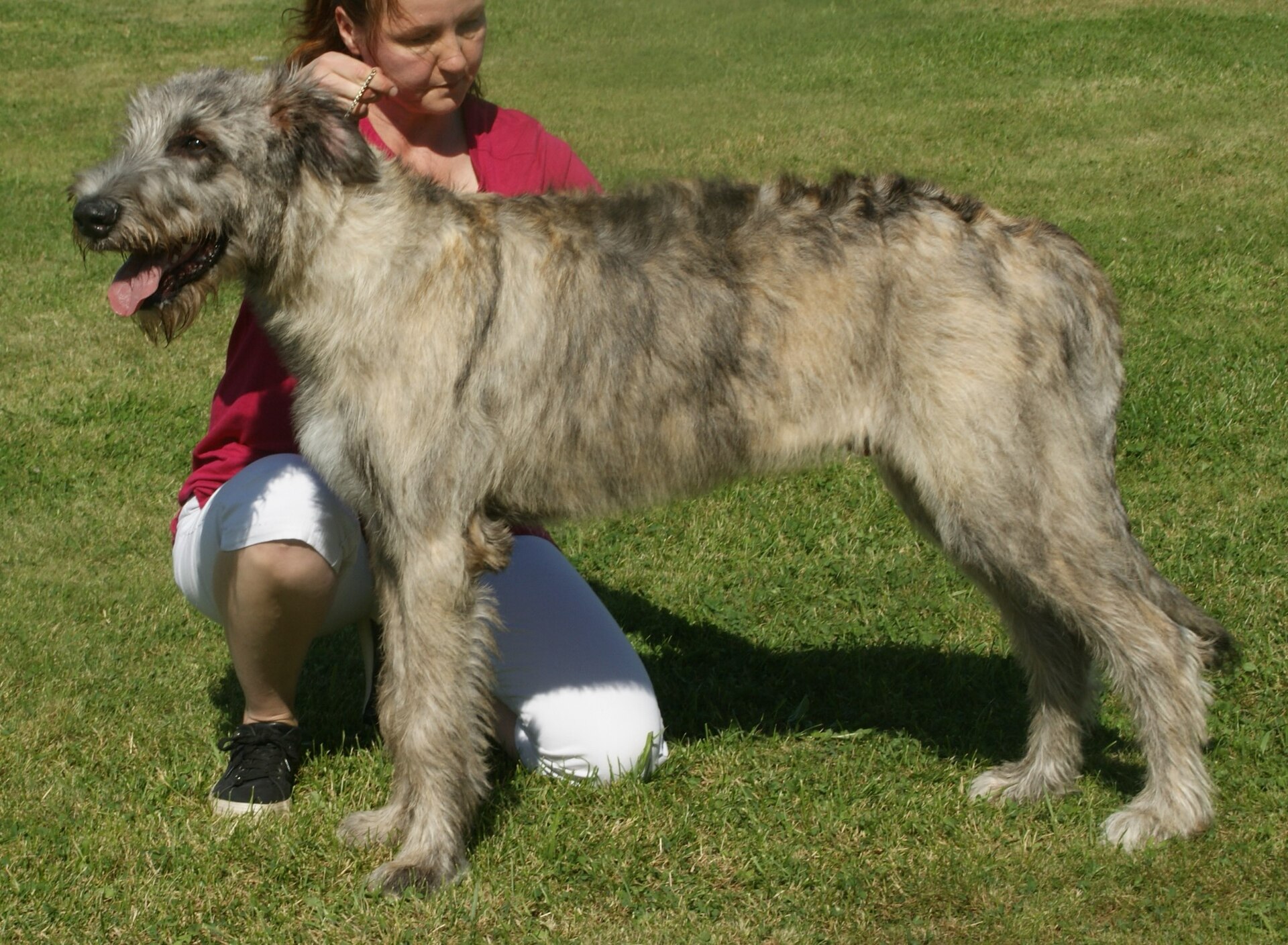
Irish Wolfhound
A rough-coated sighthound from Ireland. Club standards set a high minimum shoulder height, and they do not all use the same number.
Giant
-
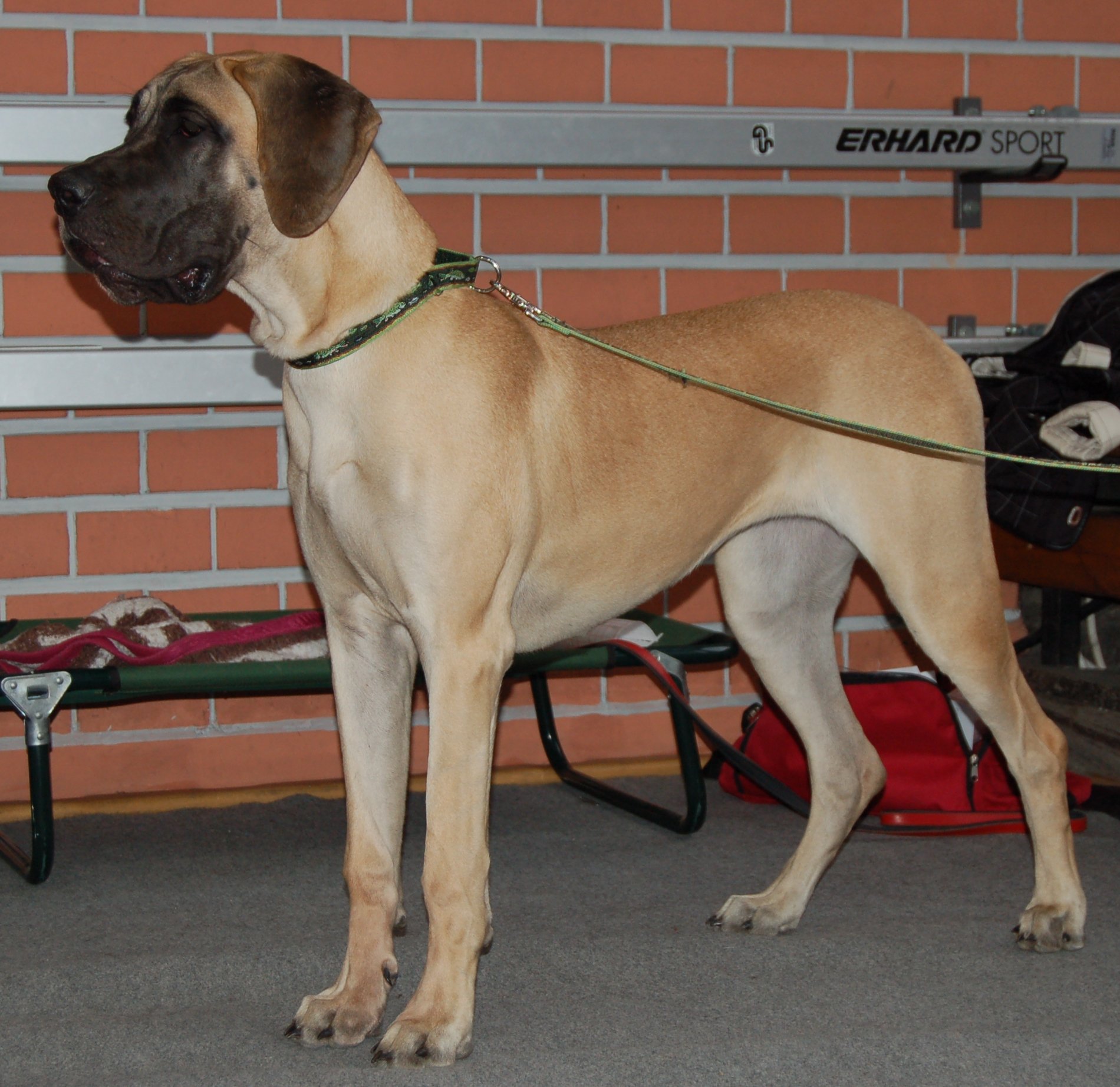
Great Dane
A tall, short-coated dog with a long narrow head and a nearly square body, developed in Germany.
Giant
-
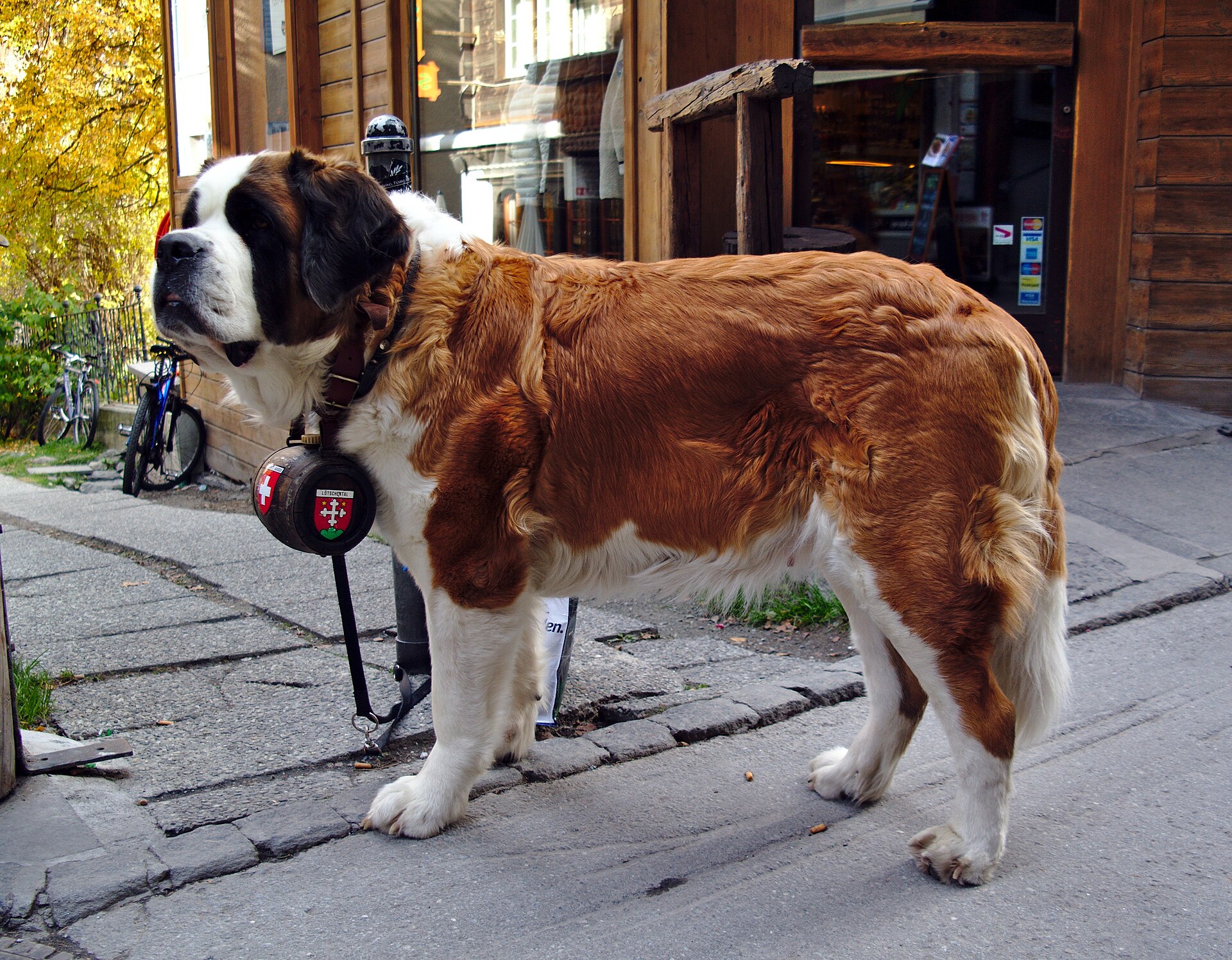
Saint Bernard
A heavy Swiss mountain dog with a broad head and either a short smooth coat or a medium-length double coat.
Giant
Tall is not the same as heavy
The Saint Bernard is a giant, and people searching for the largest dogs often land on it. Its FCI male minimum is 70 cm, lower than the Wolfhound and Dane minimums above. The AKC lists a heavy weight, 140–180 pounds for males, which is mass rather than shoulder height. A tall sighthound and a heavy mountain dog can both be called big. They are big in different directions.
The Deerhound’s minimum desirable male height is 76 cm (30 in) in the Royal Kennel Club standard, close to the Great Dane’s Kennel Club minimum and below the Wolfhound’s. The Borzoi’s FCI desirable male range, 75–85 cm, overlaps tall dogs, and its Kennel Club minimum is 74 cm (29 in). Neither is a substitute for the Wolfhound’s AKC minimum of 32 inches.
How people phrase the question
Searches for the tallest dog breed, the tallest dogs, or the largest dogs by height are the same question: adult height at the shoulder, from a breed standard. “Largest” sometimes means weight instead. When it does, use a weight listing and say so. The Dane and the Saint Bernard both have AKC weight ranges on their profiles. Those ranges are not a height ranking.
Wording about the biggest dog ever, or the tallest dog on record, is a different question again. It asks for one measured animal. This page stays with the breed standards, which is the useful comparison if you are learning the breeds rather than a single record.
Sources
- American Kennel Club, Irish Wolfhound Accessed 9 October 2026.
- The Royal Kennel Club breed standard, Irish Wolfhound Accessed 9 October 2026.
- FCI breed standard No. 160, Irish Wolfhound (10 April 2026) Accessed 9 October 2026.
- FCI breed standard No. 235, Great Dane (21 August 2024) Accessed 9 October 2026.
- American Kennel Club, Great Dane Accessed 9 October 2026.
- The Royal Kennel Club breed standard, Great Dane Accessed 9 October 2026.
- The Royal Kennel Club breed standard, Deerhound Accessed 9 October 2026.
- FCI breed standard No. 164, Deerhound (8 September 2026) Accessed 9 October 2026.
- FCI breed standard No. 193, Borzoi (4 September 2019) Accessed 9 October 2026.
- The Royal Kennel Club breed standard, Borzoi Accessed 9 October 2026.
- FCI breed standard No. 61, St. Bernard (4 April 2016) Accessed 9 October 2026.
- American Kennel Club, Saint Bernard Accessed 9 October 2026.
- The Royal Kennel Club breed standard, St. Bernard Accessed 9 October 2026.